
SLV AI Update — Launch and Operate Solana Validators Together with AI Agents from a Single Smartphone
SLV AI Update — Launch and Operate Solana Validators Together with AI Agents from a Single Smartphone
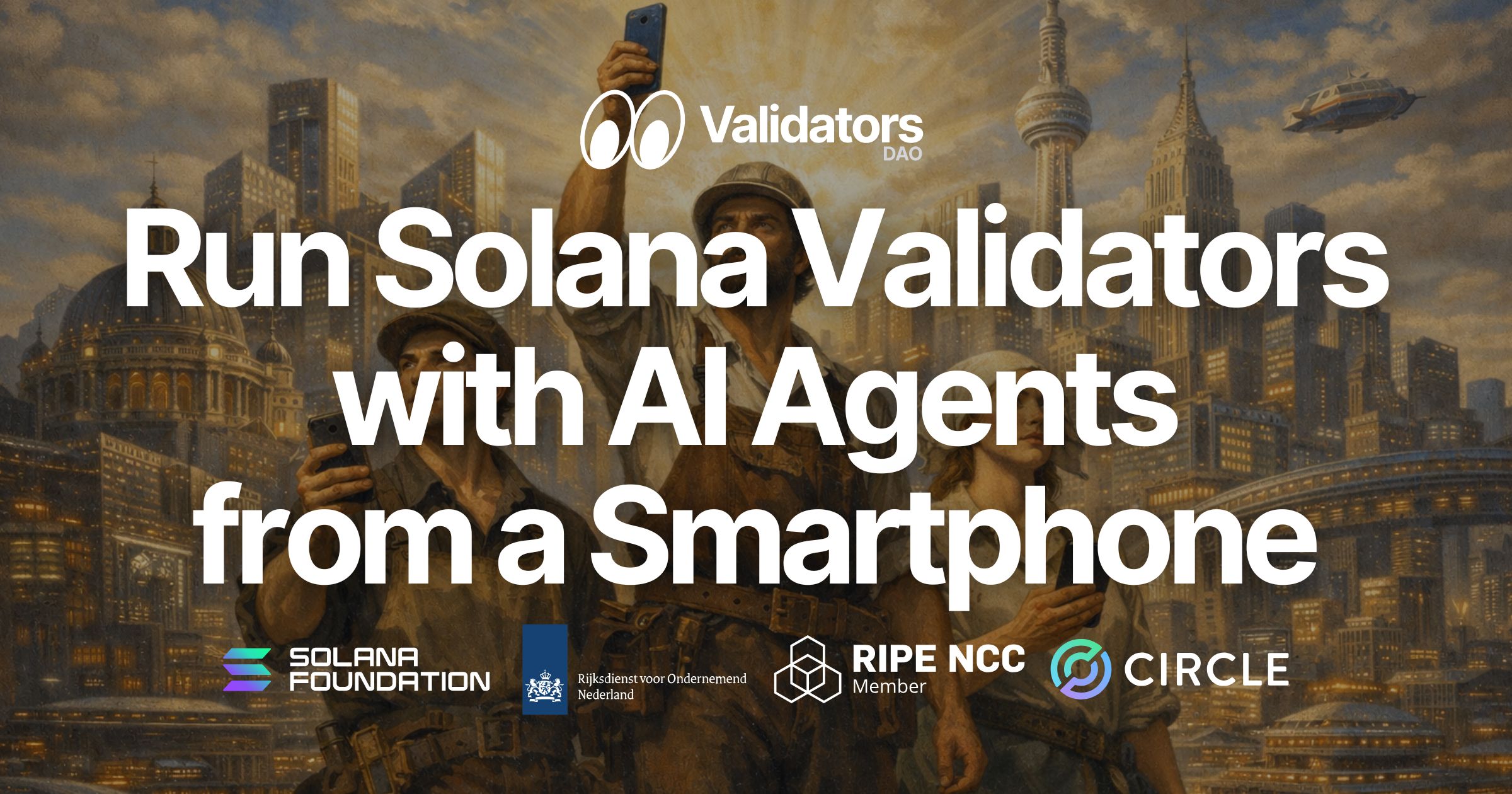
ELSOUL LABO B.V. (headquartered in Amsterdam, Netherlands; CEO: Fumitake Kawasaki) and Validators DAO have released the latest version of SLV, the open-source Solana development tool, v2026.4.10.0927. With this update, operators can launch, run, and respond to incidents on a Solana validator from a single smartphone, using only natural-language conversation with the AI agent.
SLV AI has evolved into a design that loads only the skills it needs, when it needs them. Instead of holding every capability in context at all times, only the skills relevant to the current request are invoked. This structurally reduces token consumption while still handling complex operational tasks.
YouTube video (Starting a Solana validator with an AI agent from a smartphone alone):
SLV official site: https://slv.dev
SLV GitHub: https://github.com/validatorsDAO/slv
Update Overview — v2026.4.10.0927
This release rebuilds the skill-loading mechanism of SLV AI. The AI agent parses each user request and loads only the skills and tools that are actually required for that task. Validator upgrades, Solana Geyser gRPC configuration, Solana Shredstream setup, DoubleZero client startup — each task invokes only the relevant skills.
This dynamic loading design reduces the token volume needed to execute the same operational tasks.
A Solana Validator Operated Entirely from a Smartphone
Until now, running a Solana validator required deep Linux knowledge, command-line fluency, and the parallel management of multiple terminal sessions. Sitting at a desk, opening a laptop, switching between windows — these physical constraints have placed a heavy burden on operators.
SLV AI's smartphone support removes this constraint structurally. With an SSH client on a smartphone, an operator can connect to the node, launch the AI Console, and begin operations simply by talking to the AI agent.
Running on the node itself, SLV AI broadly supports the work involved in Solana operations — building Solana validators and Solana RPC nodes, day-to-day operations, upgrades, configuration changes, and incident response. All the user has to do is express their intent in natural language.
How Mobile Operations Expand the Operator's Range
Freedom from Location Constraints
Many Solana validator operators live mobile lifestyles. Conference travel, international trips for research or business, working remotely from the road — being able to check validator status and act on it while in motion meaningfully expands operational flexibility.
In the past, this meant opening a laptop at the destination, securing a stable internet connection, and setting up a development environment before any work could begin. With SLV AI's mobile support, a smartphone is enough. An airport lounge, a moving train, a hotel lobby — operations can proceed through dialogue with the AI agent in any of these places.
Faster Response to Emergencies
Emergency updates and incident response are inherent to validator operations. New Solana network releases, client vulnerability patches, unexpected node failures — these arrive without warning, and delays in response translate directly into downtime and lost-opportunity risk.
Until now, emergency response assumed the operator could open a laptop and start working at any moment. Handling incidents while out, asleep, or on the move — situations where opening a laptop is not immediately possible — placed a significant burden on operators.
SLV AI's smartphone support reduces this burden substantially. Confirm the anomaly via a smartphone notification, open the AI Console on the spot, check the situation, and ask the AI agent to handle it — the entire flow fits in a pocket. The harsh environment of validator operations becomes day-to-day work that can be handled from a single smartphone.
Lower Barriers for New Entrants
The physical constraints of the work environment have been one of the reasons people hesitate to enter Solana validator operations. High-spec development machines, multiple monitors, a stable desk setup — the assumption that all of these are needed has acted as an entry barrier.
SLV AI's smartphone support overturns this assumption. Starting from a smartphone, anyone can begin Solana validator operations through dialogue with an AI agent. Individuals and organizations who want to contribute to the Solana network can join without first clearing technical prerequisites.
Loading Only What Is Needed — A Structural Improvement in Token Efficiency
The other major advance in SLV AI v2026.4.10.0927 is the dynamic skill-loading mechanism.
In conventional AI agent implementations, it has been common to hold every available tool and skill in context at all times. This is simple to design, but it consumes the context window at the same rate regardless of the request, and token usage grows as a structural problem.
SLV AI inverts this design. The agent now parses each request and dynamically loads only the skills it actually needs at that moment. When asked to perform a validator upgrade, only the skills related to version management and upgrade procedures are loaded. When asked to configure Solana Geyser gRPC, only the skills related to streaming configuration are loaded. Because the AI agent operates with the minimum context required for each request, the token volume needed to execute the same task is structurally reduced.
How to Use SLV AI — Just Talk to It
Setup completes through the onboarding wizard. The wizard guides the user through connecting an AI provider, selecting a model, and configuring the skills to be used. After setup, launching the AI Console allows operations to begin simply by talking to the AI agent in natural language.
"Upgrade the testnet validator to the latest Agave," "Set up a Solana Geyser gRPC stream," "Start the DoubleZero client" — when asked in this way, the AI agent confirms the current state, selects the necessary procedure, and carries it out.
Local mode is also supported. The user can run SLV AI directly on a node they have logged into via SSH, and manage that node itself with the AI agent. Connecting to a node from a smartphone SSH client and launching the AI Console there is enough to begin operations.
SLV AI Tokens — 100,000 Tokens Free with €5 Authorization
ERPC's SLV AI Tokens allow native use of SLV AI. To mark the release, a €5 authorization grants 100,000 tokens free of charge — a volume sufficient to experience this new way of operating from a smartphone.
Connection via the user's own ChatGPT or Claude API tokens is also supported, so users can run SLV AI with their own API keys. That said, the SLV AI provided by ERPC uses a model configuration optimized for the context of Solana validator and RPC operations and Solana app development, so the same token volume tends to deliver higher task accuracy and efficiency.
ERPC SLV AI Plans: https://erpc.global/price/
Contribution to the Solana Network
The physical constraints of the work environment and the cognitive load of the CLI have long been a breeding ground for operational errors in validator work. SLV AI's smartphone support and dynamic skill loading remove both of these structurally, contributing — through the stable operation of individual validators — to improvements in the processing quality and fault tolerance of the Solana network as a whole.
Backed by Performance — Epics DAO Validator Ranked World No. 3
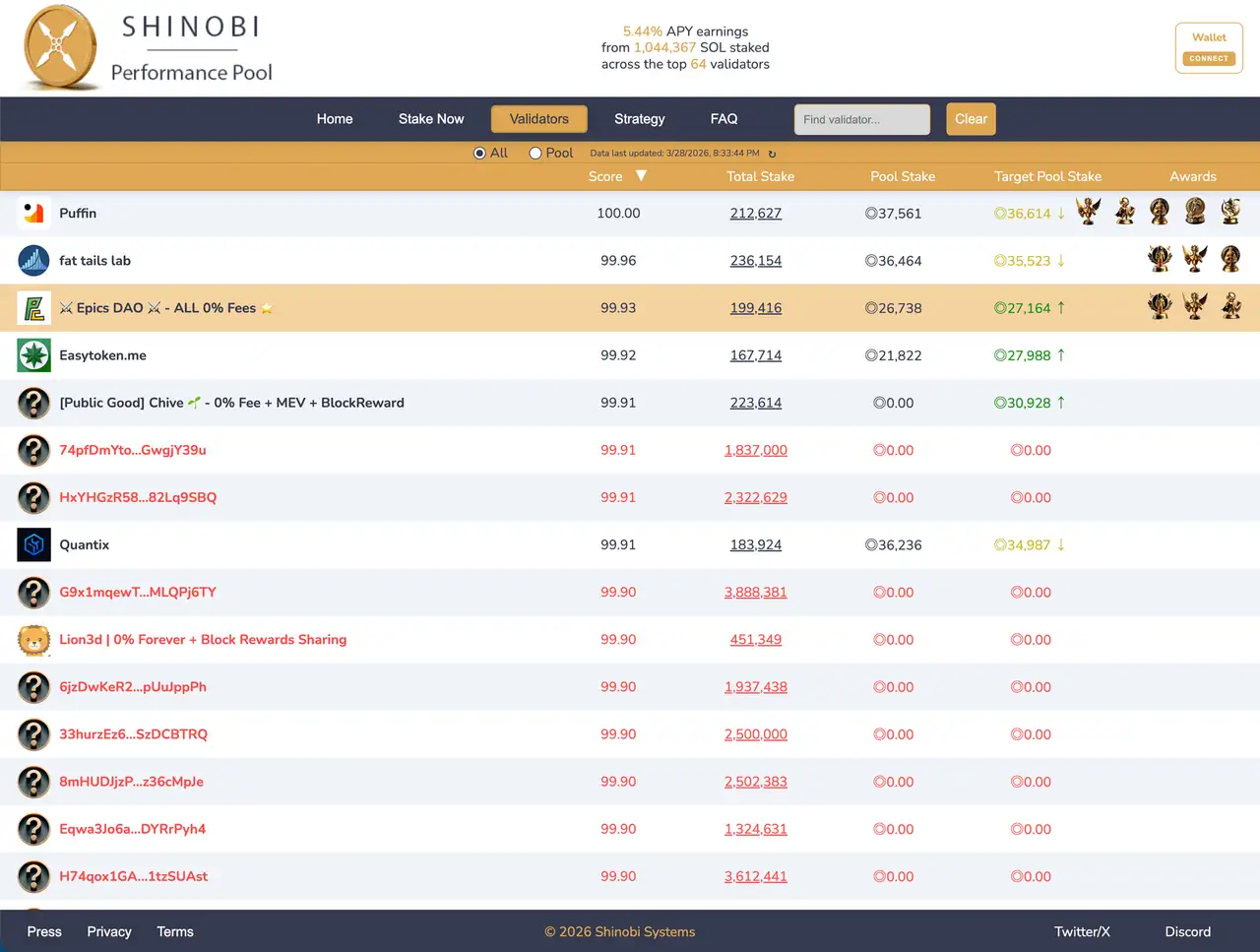
The Epics DAO validator, operated as the source of ERPC's SWQoS endpoints and Epic Shreds, has reached overall World No. 3 (score 99.93) on the Shinobi Performance Pool among all Solana validators. The operational know-how behind this result is consolidated as skills available to the SLV AI agent. Using SLV AI is the same as applying world-class validator operations know-how directly to your own environment.
Supported Clients and Roadmap
SLV currently supports Agave, Jito Agave, Firedancer, Jito Firedancer, DoubleZero, and the SHA256 optimization patch.
Upcoming updates will add support for various Vote Mods, Solana custom clients, and the AllNodes Client, rolling out from next month through the summer. By bringing the extensions actually used in the field into SLV, we are laying the groundwork for more operators to move to an AI-agent-based operational environment.
Combined with the ERPC Platform
Using SLV on the ERPC platform gives operators fast in-platform snapshot downloads, zero-distance communication with Solana validators, and Solana-tuned configurations from the very first moment. Solana RPC, Solana Geyser gRPC, Solana Shredstream (Epic Shreds), bare metal servers, high-performance VPS, and ERPC Global Storage are all integrated within the same platform.
DoubleZero's dedicated fiber network is also integrated across all regions, achieving roughly 200ms P99 latency reduction in Asian regions in particular (Tokyo and Singapore). Environments built by the SLV AI agent benefit from these infrastructure optimizations with no additional configuration.
ERPC official site: https://erpc.global
Provided as Open Source
SLV itself remains open source. The source code is available on GitHub for free use, modification, and redistribution. SLV AI Tokens are a managed service for using the AI agent operations in a form integrated with SLV itself. Users can choose either to connect their own AI provider and use SLV's open-source features, or to use SLV AI Tokens to start with a native AI-agent operations environment immediately.
SLV GitHub: https://github.com/validatorsDAO/slv
Five Consecutive Years of WBSO Approval
ELSOUL LABO has received approval under the Dutch government's WBSO R&D support program for five consecutive years since 2022. The continuous research and development on Solana RPC infrastructure, validator operations orchestration, and AI-agent-driven Solana operations environments is implemented directly in SLV's tooling and AI agent. The opening of a Solana-specialized data center under our own ASN AS200261, granted by RIPE NCC, is also planned for this month and will support further acceleration of the environments built by the SLV AI agent.
Contact
For inquiries about SLV and ERPC, please open a support ticket on the official Validators DAO Discord.
Validators DAO official Discord: https://discord.gg/C7ZQSrCkYR
Links
- SLV official site: https://slv.dev
- SLV Getting Started: https://slv.dev/doc/general/getting-started/
- SLV GitHub: https://github.com/validatorsDAO/slv
- ERPC official site: https://erpc.global
- ERPC SLV AI Plans: https://erpc.global/price/
- YouTube video (Starting a Solana validator with an AI agent from a smartphone alone):
- Epics DAO official site: https://epics.dev
- Validators DAO official Discord: https://discord.gg/C7ZQSrCkYR
News