
ERPC Applies Performance Boost to All Dedicated Solana Shreds Plans Across All Regions — 150–200ms P99 Latency Improvement Observed, Product Renewal at No Price Increase
ERPC Applies Performance Boost to All Dedicated Solana Shreds Plans Across All Regions — 150–200ms P99 Latency Improvement Observed, Product Renewal at No Price Increase
ELSOUL LABO B.V. (Headquarters: Amsterdam, Netherlands; CEO: Fumitake Kawasaki) and Validators DAO are pleased to announce that ERPC has applied a research-driven performance boost to all dedicated Solana Shreds plans across all regions.
Testing has confirmed P99 latency improvements of 150–200ms. This upgrade is delivered as a product renewal at no additional cost.
Performance Boost Overview
Systematic Elimination of Power-Saving and Performance-Throttling
This performance boost is built on a design philosophy of systematically eliminating all power-saving and performance-throttling mechanisms.
In the server industry, conservative configurations that prioritize stability, power efficiency, and general-purpose compatibility are the norm. However, in Shredstream reception and delivery — where every millisecond determines competitive position — these conservative defaults become a hard ceiling on performance.
For ERPC's dedicated Shreds, we have disabled CPU C-states, locked CPU governors to performance mode, optimized kernel parameters, tuned the network stack, and refined memory configurations — eliminating power-saving and performance-throttling mechanisms at every layer to apply a speed-first configuration optimized for Shreds reception.
150–200ms P99 Latency Improvement Observed
Following the application of this performance boost, P99 latency improvements of 150–200ms have been observed. On Solana, latency improvement at this scale directly affects the arrival order of Shreds — a decisive competitive advantage in high-frequency trading, DeFi, and real-time processing.
Covered Plans and Configurations
The performance boost has been applied to all dedicated Shreds plans. Below are example configurations from the limited-quantity Direct Shreds Limited Editions lineup.
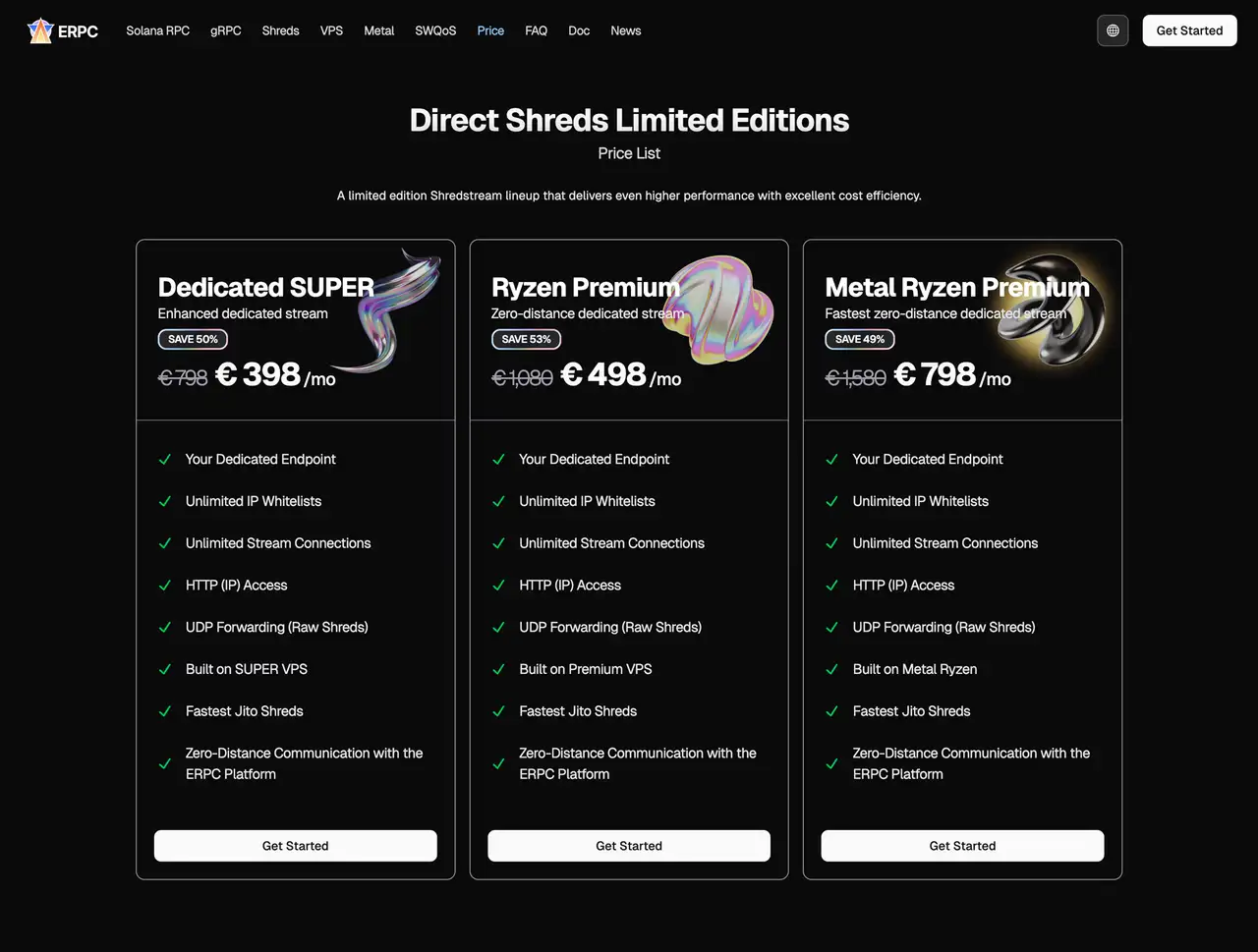
- Dedicated SUPER (€398/mo) — Enhanced dedicated stream built on SUPER VPS
- Ryzen Premium (€498/mo) — Zero-distance dedicated stream built on Premium VPS
- Metal Ryzen Premium (€798/mo) — Fastest zero-distance dedicated stream built on Metal Ryzen
All plans maintain the following quality standards: your dedicated endpoint, unlimited IP whitelists, unlimited stream connections, HTTP (IP) access, UDP Forwarding (Raw Shreds), Fastest Jito Shreds, and zero-distance communication with the ERPC platform. Prices remain unchanged — only performance has improved.
ERPC Shreds: https://erpc.global/en/shreds/
Why We Build the Fastest Platform Ourselves
Trust and Brand Names Cannot Deliver the Fastest Infrastructure
The reason we committed to building our own high-performance platform is straightforward. As long as you place servers in a datacenter, trust and brand names alone cannot get you the fastest environment.
No matter how large a provider appears, no matter how large and high-quality their network actually is, the quality of resources delivered changes based on the customer's level of knowledge — this is the reality of the server industry.
There is a structural reason for this. With server products, it is difficult to accurately determine how much performance you are actually getting unless you have the knowledge to measure it. Without that knowledge, a high-speed environment is simply out of reach. Unless you know where performance throttling exists and what happens when you remove it, performance remains locked away.
The Incentive Structure on the Datacenter Side
In the server industry, datacenter providers have a constant incentive to conserve power and network bandwidth because doing so directly increases their profitability. The less power consumed, the less bandwidth allocated, the cheaper the parts used — the larger the margin. This is structural.
On the Solana blockchain, a healthy incentive structure exists: running a high-quality validator leads to rewards. However, the same healthy incentive does not exist between datacenter providers and their customers. When a customer's performance improves, the datacenter's revenue does not increase.
Requesting "The Fastest" Does Not Deliver the Fastest
Let us share our experience.
In the past, we contacted every datacenter we could reach, searching for the optimal network for Solana. In the early days, our knowledge was not what it is today, and we started by asking provider after provider about high-speed server and network environments.
Our requirement was simple: build the fastest hardware and network possible. We placed server orders using exactly that word — "fastest." This was the starting point of not knowing enough.
We tried to obtain "the fastest" through trust. When we asked a major vendor to help us achieve "the fastest," what appeared in the quote was a premium-priced network card that was a decade out of date. There was no way this could deliver the fastest performance.
But from the datacenter's perspective, if a ten-year-old network card can be included without the customer noticing, there is an incentive to do exactly that — it becomes pure margin. If the customer cannot detect it, the configuration ships. Structurally, that is how it works.
Yet this is a structure that clearly impedes innovation.
Enabling Focus on Core Expertise Accelerates Innovation
With the evolution of AI agents, we have entered an era where smaller teams than ever can produce outsized results. Each organization focuses on its own area of expertise, and collectively, society achieves innovation — that is the shape of the future.
But realizing this requires infrastructure. And network infrastructure currently has a bottleneck.
An environment where users pursuing the fastest performance cannot obtain it simply because infrastructure is not their specialty — that is not a well-functioning ecosystem. We started this business with the conviction that an infrastructure service must exist where users chasing maximum speed receive it by default, without having to become infrastructure experts themselves.
The Structural Problem ERPC Solves
Building a Fast Solana Environment Has Required Deep Expertise
Until now, building a high-speed application environment on Solana required a complex, multi-step process.
First, investigate which datacenter your RPC vendor's servers are located in. Then source bare metal servers from multiple vendors within the same facility or network, collecting and comparing quotes. Even if you successfully procure a server, in most cases it arrives without any Solana-specific optimization, with performance-throttling features still enabled. From there, you must audit and tune every layer yourself before a high-speed environment is finally achieved.
Completing this process requires broad and deep knowledge spanning network design, hardware selection, OS-level tuning, and the mechanics of the Solana protocol. In reality, many users today still cannot access high-speed environments because they lack this knowledge and procurement capability.
ERPC's Approach — Deploy Within the Platform, Get the Fastest Environment from the Start
ERPC integrates the Solana RPC platform with user-deployable bare metal servers, VPS instances, and Shreds environments within a single platform.
Users do not need to investigate where the RPC servers are located. They do not need to source bare metal servers from a separate vendor. They do not need to find and disable performance throttling on their own. By deploying within the ERPC platform, the fastest communication paths, fully optimized configurations, and Solana-specific tuning are all available from the start.
Deep datacenter expertise is not required to obtain the fastest environment — this is ERPC's design philosophy, and the reason we continue building our own platform.
Dedicated Shreds Design Philosophy — Speed as the First Requirement
What Latency Means in Shredstream
Solana's Shredstream is a mechanism for receiving block data fragments (Shreds) from validators in real time. By obtaining data at the Shreds level without waiting for block finalization, it becomes possible to access transaction information significantly earlier than through standard RPC.
In this domain, differences of tens of milliseconds determine transaction ordering. The 150–200ms P99 latency improvement from this performance boost represents a structural advancement in the timing of information acquisition.
Zero-Distance Communication with the ERPC Platform
All dedicated Shreds plans are co-located within the same network as the ERPC platform. From Shreds reception through RPC and gRPC connectivity, this configuration completes all communication within the same network without traversing external routes — achieving the shortest possible communication path dictated by physics.
Where other providers receive Shreds from outside the network, ERPC's dedicated Shreds receive them from within the same network as the source — a structural advantage that cannot be closed through tuning alone.
Additional Improvement from HTTP Migration Across All Regions
The recent HTTP migration across all regions (eliminating TLS overhead) has also delivered a direct benefit to Shreds delivery. P99 latency improvements of 120ms or more have already been achieved on both gRPC and Shreds, and combined with this performance boost, cumulative latency improvements continue to compound.
Research Outcomes Exist to Be Returned to Users
Reflecting Upgrades to Existing Users
ERPC's research and development outcomes are always returned to all users. Upgrade improvements are applied to existing customers on an ongoing basis.
This performance boost is being rolled out sequentially. Customers requiring expedited application may request a dedicated maintenance window via support ticket.
Five Consecutive Years of WBSO Approval — R&D Directly Driving Performance Improvements
ELSOUL LABO has received five consecutive years of approval under the Dutch government's WBSO R&D incentive program since 2022. Research continues on ultra-low-latency Solana RPC infrastructure and automation of validator placement and operational orchestration, with outcomes reflected directly in platform performance improvements.
R&D results are cumulative, and the rate of improvement accelerates over time. For users whose value is directly tied to performance, ERPC's quality is something that continues to evolve.
Next-Generation Option — AS200261 Solana-Dedicated Datacenter
ELSOUL LABO has been assigned its own ASN (AS200261) by RIPE NCC and is proceeding with the opening of a Solana-dedicated top-tier datacenter. Designed to surpass existing premium datacenters as the highest-quality infrastructure available, it is expected to become operational from the end of this month through next month.
The hardware configuration is unified around the latest generation: 5th Gen AMD EPYC, 5th Gen AMD Threadripper PRO (9975WX and equivalent), and 5th Gen NVMe, combined with optimal network route design through the company's own ASN. This delivers on what was previously considered a trade-off — simultaneously achieving top-tier performance and ASN concentration score advantage.
The initial lot is fully reserved, but subsequent inventory will be offered in waitlist order.
Contact
For inquiries about dedicated Shreds, please create a support ticket via the Validators DAO official Discord.
Validators DAO Discord: https://discord.gg/C7ZQSrCkYR
For official information and plan details, please visit:
ERPC Website: https://erpc.global/en
Thank you for your continued support of ERPC.
News