
ERPC Restocks Dedicated Premium Shreds and VPS for Solana in the Rapidly Growing Tokyo Region
ERPC Restocks Dedicated Premium Shreds and VPS for Solana in the Rapidly Growing Tokyo Region
ERPC, operated by Validators DAO together with ELSOUL LABO B.V. (Headquarters: Amsterdam, the Netherlands; CEO: Fumitake Kawasaki), announces that it has carried out a restock and additional procurement of Solana-focused Premium VPS, Bare Metal Servers, and Dedicated Shreds services in the increasingly in-demand Tokyo (TY) region, expanding available capacity and strengthening resources across the entire region.
This restock is not a short-term inventory adjustment. Based on the premise that physical distance, network distance, and congestion tolerance directly affect outcomes in real-world Solana operations, ERPC has continuously invested in and reinforced the Tokyo region. With this round as well, new nodes and network resources have been added, simultaneously increasing both processing capacity and data acquisition capacity across the Tokyo region.
The Importance of the Tokyo Region and Structural Changes Now Underway
In Solana, physical distance and network distance directly translate into latency, detection speed, and transaction success rates. Within the Asia-Pacific region in particular, infrastructure deployed near Tokyo occupies a structurally advantageous position for use cases such as HFT, MEV, high-speed transaction submission, and real-time analytics.
Tokyo is a major connection point where key submarine cables linking North America and Asia converge, and it has a network structure that naturally aggregates traffic not only from within Japan, but also from major Asian regions such as South Korea, Taiwan, Hong Kong, and Singapore. As a result, it tends to support shorter paths with lower jitter, making stable connectivity easier to achieve.
In networks like Solana, where large volumes of streaming data such as Shreds and gRPC events flow continuously, not only low average latency but also path consistency and stability under congestion directly affect processing outcomes. The Tokyo region offers favorable conditions for stable high-speed operation in Asia thanks to the wide choice of ISPs and IXs and the relative ease of building redundancy.
At the same time, high-quality Solana-oriented RPC and Shred acquisition infrastructure designed to fully leverage these characteristics is still not sufficiently developed in Tokyo. ERPC identified this structural gap early and has been investing in and building out the Tokyo region well before demand became visible.
ERPC’s Architectural Policy in the Tokyo Region
In the Tokyo region, ERPC places RPC, Geyser gRPC, Shredstream, and Dedicated Shreds within the same data center or adjacent network environment, maintaining an architecture that avoids fragmentation across the acquisition, processing, and transmission layers.
By minimizing paths that traverse the public internet and segments prone to transit congestion, this approach reduces latency variance and prevents transient degradation from impacting real-world operations. For workloads that handle continuously flowing data such as Shreds and gRPC streams, path consistency and stability directly determine results.
The latest Tokyo region reinforcement has been implemented based on this same architectural policy, keeping the acquisition layer through the application layer under a unified set of assumptions.
Service Lines with Expanded Capacity in the Tokyo Region
Through this restock and additional procurement, ERPC has expanded capacity for the following service lines in the Tokyo region:
- VPS
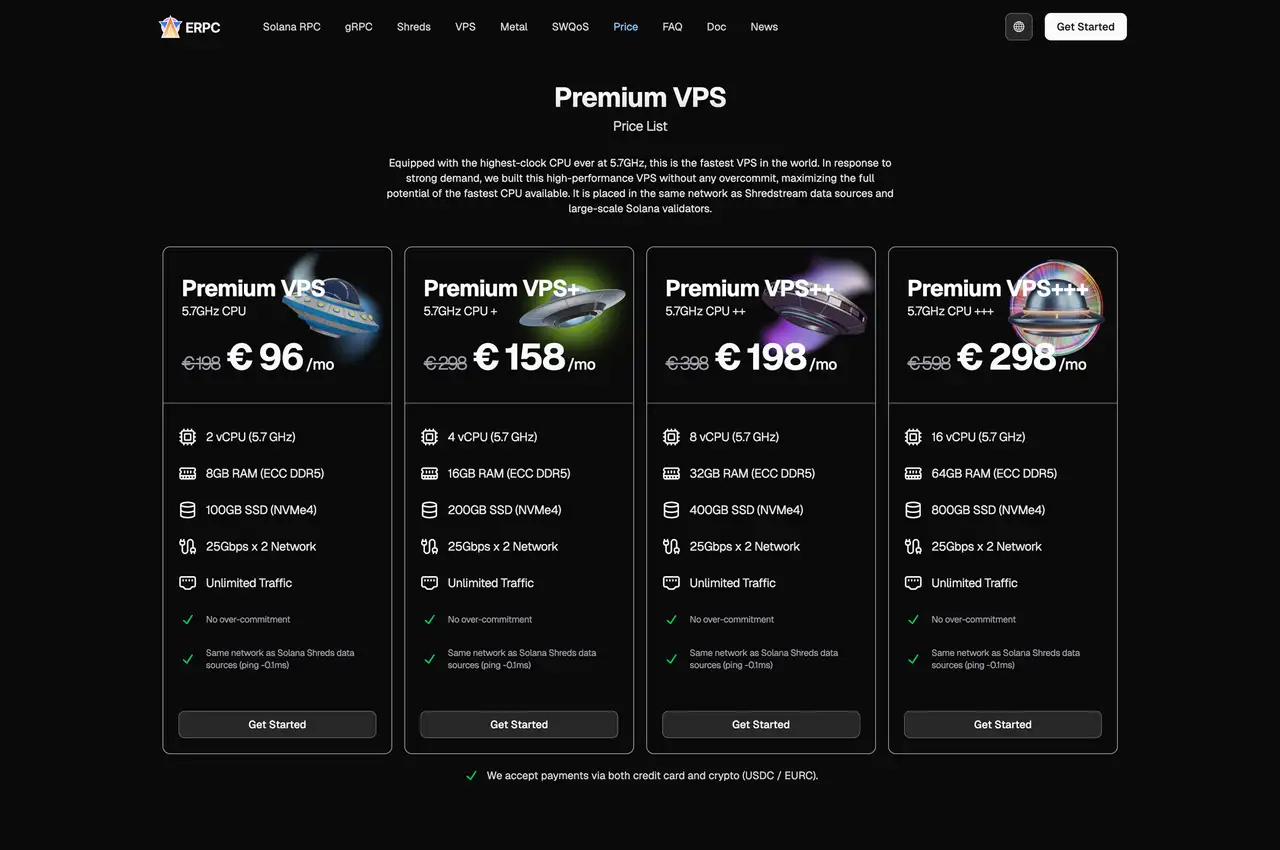
- Premium VPS
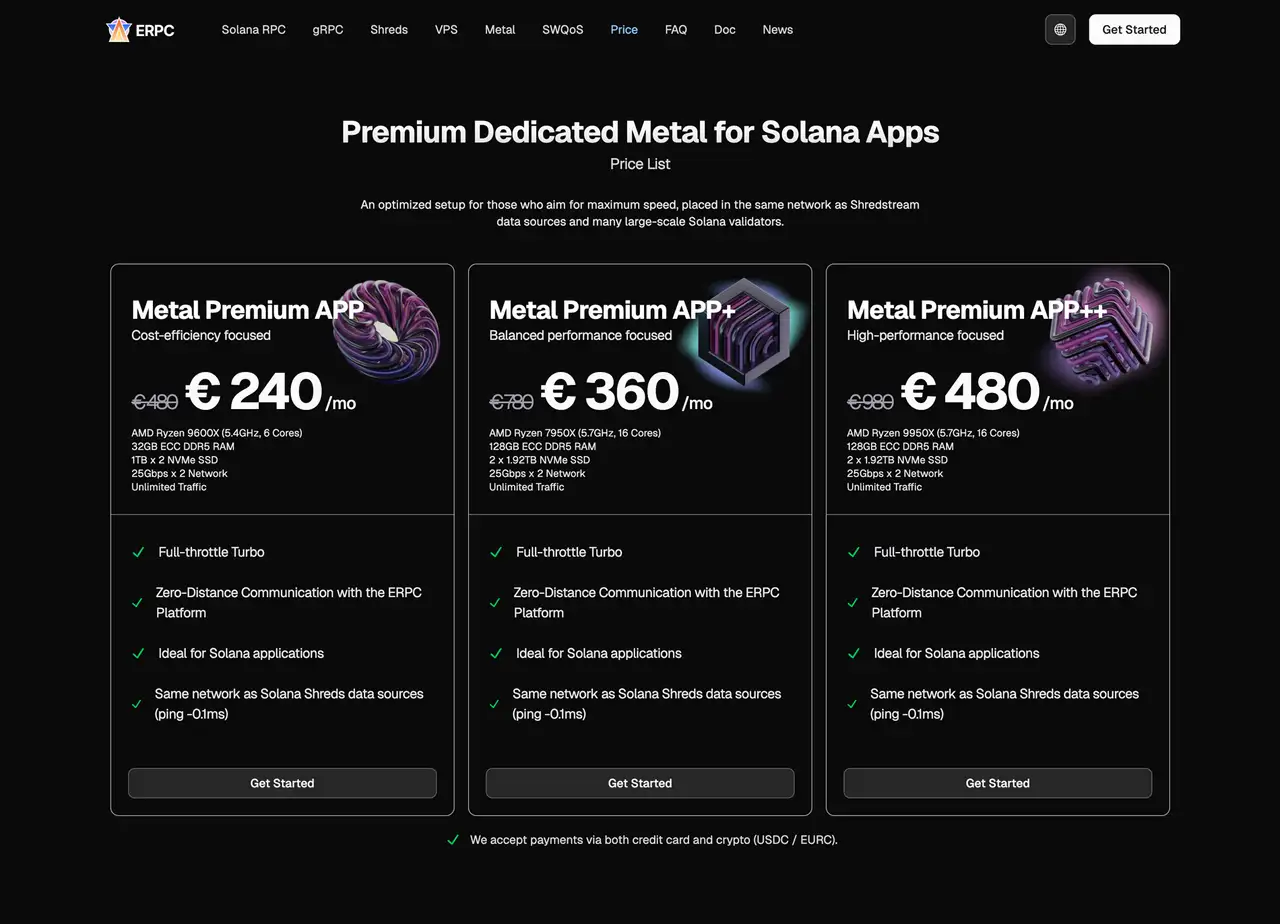
- Premium Bare Metal Servers
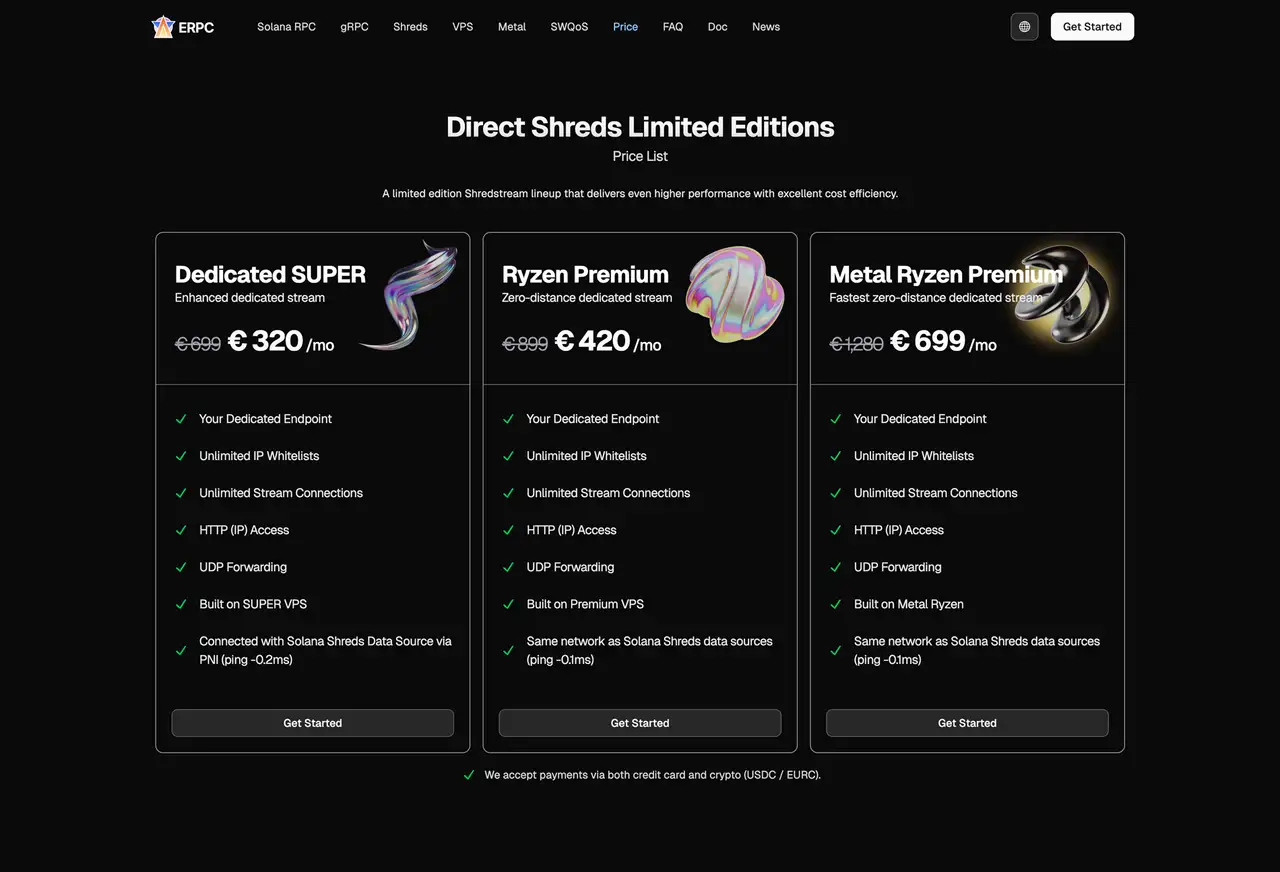
- Dedicated Shreds
- Premium Dedicated Shreds (including Limited Editions)
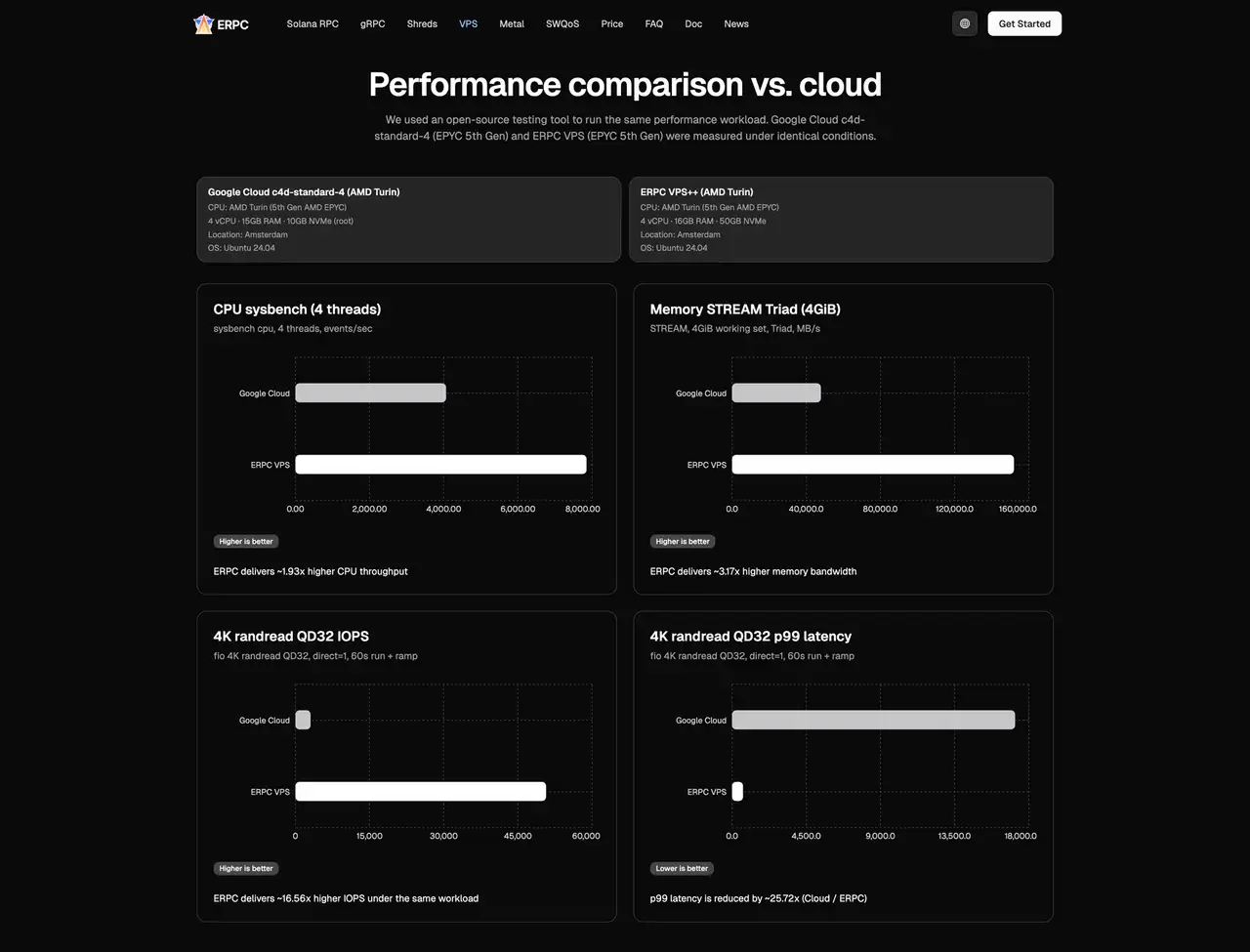
ERPC’s Premium VPS is built without CPU overcommit and assumes stable high-clock operation on the latest-generation CPUs, in contrast to general-purpose cloud environments. In addition, by avoiding unnecessary virtualization layers in storage I/O and network paths, it suppresses not only average latency but also tail latency, including p99.
In measured benchmarks comparing ERPC VPS with high-performance Google Cloud configurations under the same region and OS conditions, differences were observed across CPU throughput, memory bandwidth, disk I/O, and p99 latency. These results do not come from benchmark-only tuning, but reflect differences in fundamental design assumptions such as CPU clock policy, the presence or absence of overcommit, and network and storage architecture.
Dedicated Shreds and Premium Dedicated Shreds further isolate the acquisition layer as dedicated resources, reducing transient congestion and data loss that can occur in shared environments. This makes it easier to assemble transaction submission, detection, and analysis workflows near Tokyo under consistent operating assumptions.
Pricing and Provisioning Policy
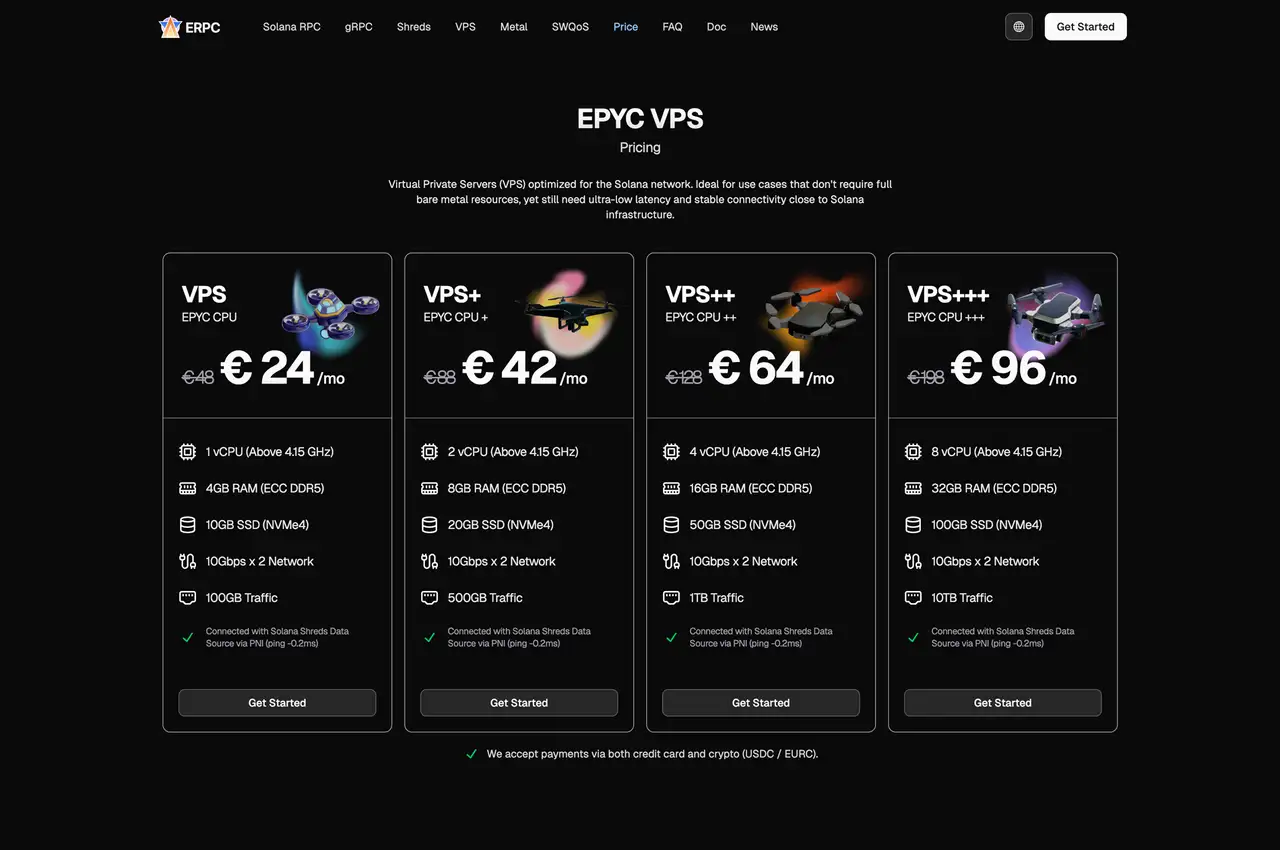
During the phase of strengthening its global edge, ERPC has prioritized resource expansion over short-term profit. As a result, some Premium VPS and Dedicated Shreds configurations are still offered within a pricing range that would normally be difficult to sustain at this quality level.
At the same time, the rapid expansion of AI demand has driven a sharp global increase in server hardware prices. The earliest and strongest impact has been seen in high-quality, supply-constrained components such as latest-generation CPUs, ECC memory, and high-performance NVMe storage. When demand concentrates, these components are the first to disappear from the market and to experience rapid price increases.
ERPC’s premium configurations depend precisely on these limited, high-quality resources. As procurement shifts later, conditions deteriorate, making it structurally difficult to maintain the same quality at the same price.
Rising memory prices are already evident in the consumer market, and cost increases are even more pronounced in server-grade components. In response, ERPC secures resources earlier where possible and follows a policy of maintaining and expanding quality across its global edge.
Current pricing is not the result of temporary promotions, but of procurement timing and resource acquisition strategy. As regions mature and demand concentrates, maintaining these conditions becomes increasingly difficult. The Tokyo region is currently at that transitional stage.
Recent Developments in Solana and the Irreversible Rise in Infrastructure Requirements
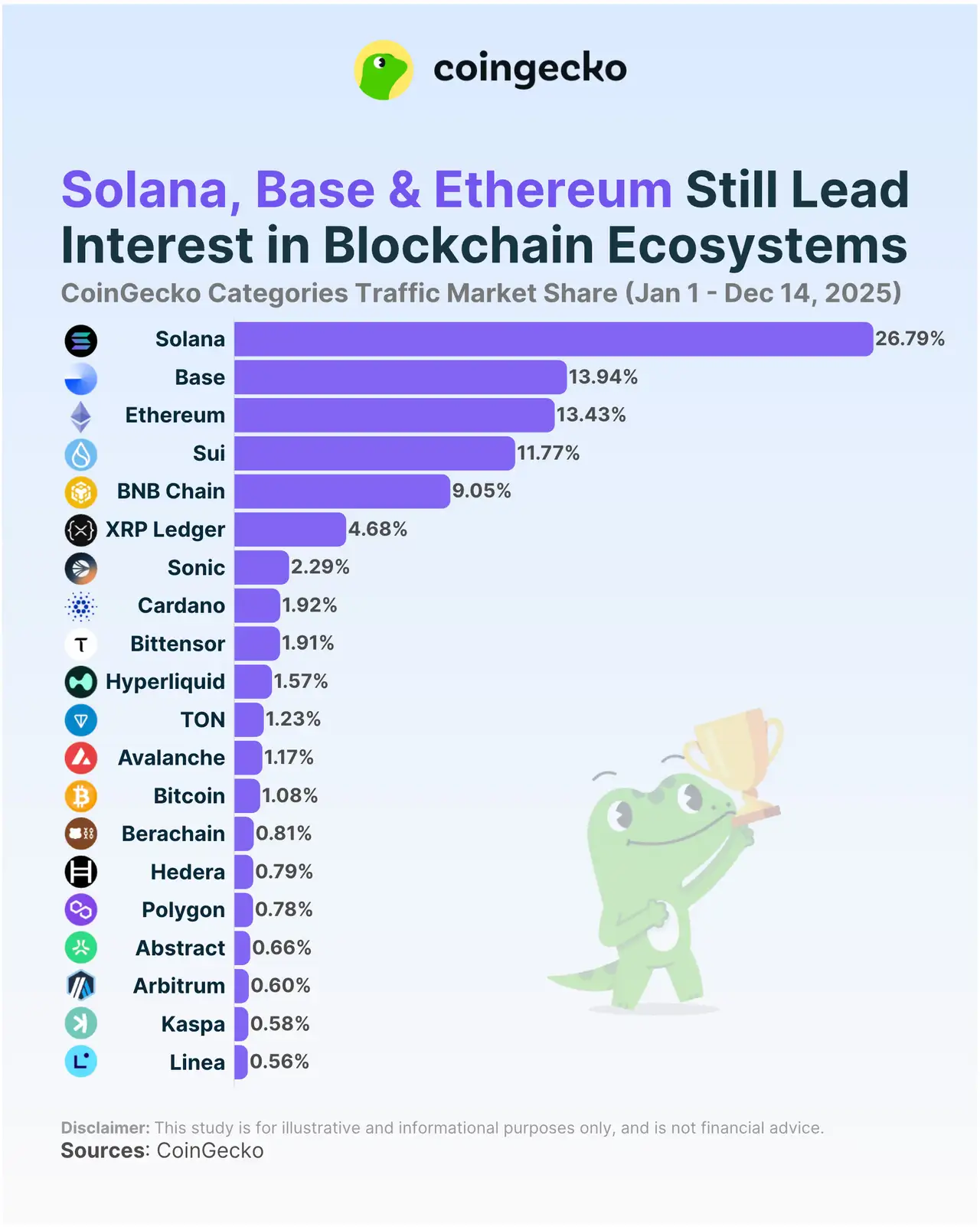
According to CoinGecko research, Solana accounts for 26.79% of blockchain ecosystem interest in 2025 (Categories traffic market share), placing it well ahead of other major chains. This metric reflects actual user behavior and information flow rather than price or speculative attention, indicating that development, usage, and commerce are concentrating on Solana.
Reference: https://www.coingecko.com/research/publications/most-popular-blockchain-ecosystems
Reference: https://www.coingecko.com/research/publications/most-popular-blockchain-ecosystems
Rising attention directly leads to increased network load. Pipe Network reported that Solana experienced sustained DDoS attacks over the past week, peaking at approximately 6 Tbps. This corresponds to traffic equivalent to roughly 240,000 simultaneous 4K video streams.
Reference: https://x.com/pipenetwork/status/2000812111929221500
Reference: https://x.com/pipenetwork/status/2000812111929221500
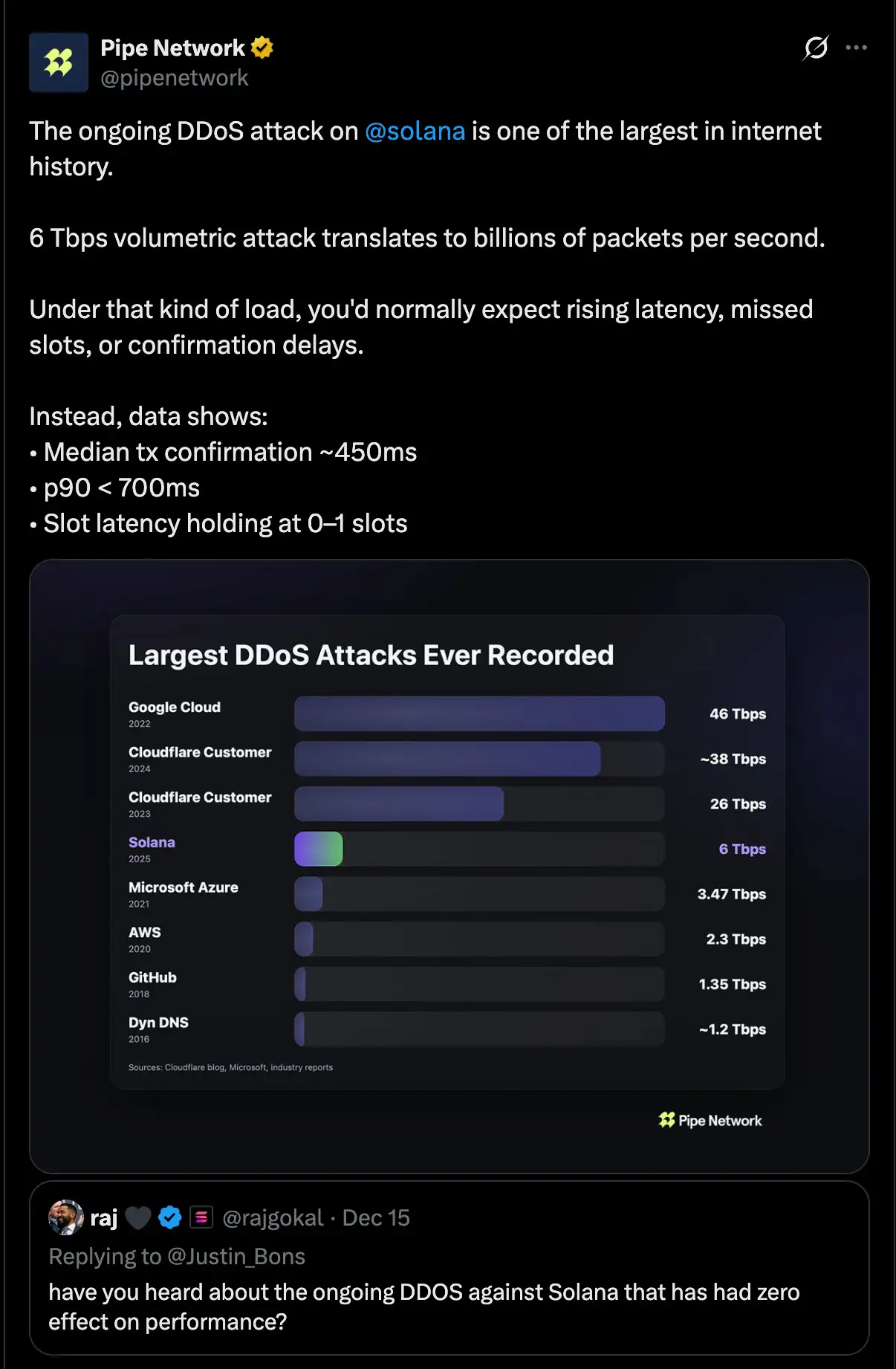
This scale is comparable to major attacks previously seen against Google Cloud and Cloudflare customers, indicating that the load conditions that must be assumed in real-world operations have fundamentally changed. Despite this, no significant delays in transaction confirmation or block production have been observed on Solana.
Crucially, this resilience is not provided by a single company or centralized operator. The Solana network is supported by individual validators operating around the world, each maintaining and improving their systems under high-load assumptions. The fact that performance characteristics were preserved even under these attacks reflects the reality that validator operators are seriously committed to real-world operations. Network resilience is not determined solely by specifications or theoretical design, but is built through continuous operational decisions and incremental improvement.
At the same time, in the payments sector, Visa announced the launch of institutional USDC-based stablecoin settlement, marking a phase where on-chain processing is being integrated into real financial operations. As rising attention, increased real traffic, expanding attack scale, and financial adoption converge, infrastructure requirements around Solana are being raised to a level that assumes operational commitment and implementation capability.
ERPC Operations and Resilience
ERPC designs and operates its infrastructure with these environmental changes as a baseline. Working with trusted data center partners, it continues to strengthen network redundancy, path diversity, and configurations that are less susceptible to congestion.
At the server level, ERPC combines latest-generation hardware with firewall controls and continuous monitoring using nftables. These measures are not intended simply to block traffic, but to detect abnormal increases and behavioral changes early and to maintain stable processing paths and resource usage.
For workloads that continuously process data such as Shreds and gRPC streams, transient congestion or external disturbances can directly result in detection delays or data loss. ERPC therefore maintains a unified design assumption from the acquisition layer through the application layer, minimizing external variability.
As DDoS attack scales exceed assumptions based on conventional cloud models, infrastructure is required not merely to stay online, but to preserve performance characteristics under stress. ERPC delivers Solana’s speed in a form that can be used for real-world services and products by accumulating this operational discipline in practice.
Using the Tokyo Region
While the Tokyo region is expected to continue increasing in importance, it remains a phase where high-quality resources can still be secured. This restock provides a practical option for developers and operators conducting high-speed processing, detection, and real-time analytics near Asia.
For configuration details, availability, and optimization discussions, please contact us via the Validators DAO official Discord.
Validators DAO Official Discord: https://discord.gg/C7ZQSrCkYR
ERPC Official Site: https://erpc.global/
ERPC Official Site: https://erpc.global/
News